The Drift and the Discovery: Why America's Finest Clubs Are Engineering the Art of the Unplanned Encounter
There is a particular kind of conversation that cannot be manufactured. It begins without agenda, unfolds without obligation, and concludes without the faint awkwardness of a business card exchange. It is the exchange that happens when two people simply find themselves in the same unhurried space at the same unhurried moment. For decades, America's most prestigious private clubs understood this instinctively. Lately, they have begun to design for it with extraordinary intention.
The irony is deliberate and not lost on those who study these institutions closely. The most carefully engineered social environments of our time are being built to feel as though nothing was engineered at all.
The Problem with the Formal Introduction
For much of the twentieth century, the private club functioned as a choreographed stage. Membership committees curated rosters. Event directors produced calendars. Introductions were brokered, vetted, and delivered with ceremony. The result was an environment that, for all its exclusivity, could feel surprisingly transactional — a velvet-lined version of the very professional machinery its members sought to escape.
The most perceptive club directors began noticing a shift in member sentiment roughly a decade ago. Attendance at structured cocktail receptions plateaued. Formal speaker dinners drew thinner crowds. Meanwhile, the club's most loyal members — the ones who renewed without hesitation and brought guests with quiet pride — were gravitating toward something else entirely: the long afternoon in the reading room that turned into an unplanned supper, the chance meeting at the bar cart that became a two-hour conversation about everything except business.
What members were craving, it turned out, was not more programming. They were craving permission to simply be.
Spatial Alchemy: Designing the Corridor of Possibility
The architectural response to this insight has been one of the more fascinating developments in high-end hospitality over the past several years. Club designers and interior strategists — working alongside membership directors and behavioral consultants — have begun reimagining the physical flow of clubhouses to maximize what some in the field now refer to as "ambient sociability."
The principle is deceptively simple: if you want members to encounter one another organically, you must design spaces that slow them down, invite lingering, and create natural gathering points that serve no single, declared purpose.
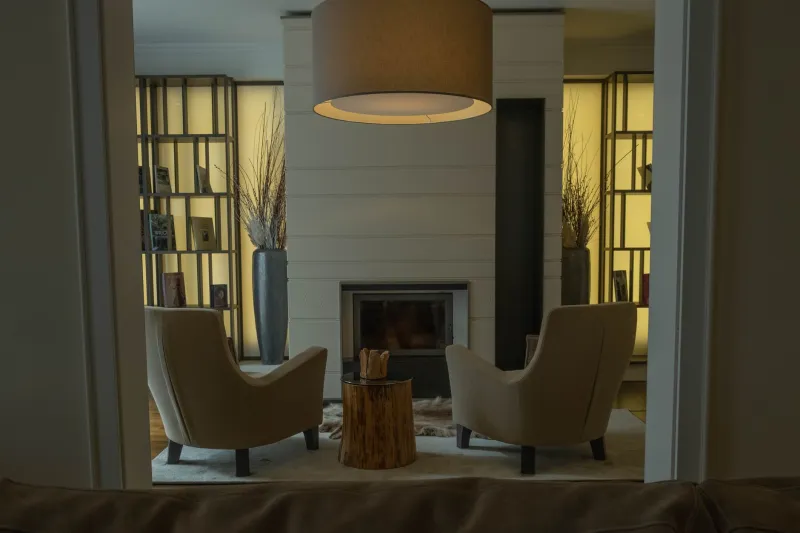
This has translated into a range of deliberate interventions. Wide, generously furnished corridors replace narrow passageways. Libraries are positioned between dining rooms and lounges rather than tucked away as destination spaces. Bar areas are sized and lit to encourage the solitary visitor to feel comfortable — and, crucially, approachable — rather than conspicuous. Reading chairs face outward. Fireplaces anchor corners where two strangers might reasonably find themselves sharing warmth without formal cause.
Some of the more progressive clubs along the Eastern Seaboard and in Chicago have gone further still, eliminating what one design director described as "purpose anchors" — the clearly delineated zones that signal to a member exactly where they should be and, by extension, exactly who they should be speaking to. In their place are fluid, multi-use rooms that accommodate the quiet worker, the casual luncher, and the impromptu gathering with equal grace.
The Programming of Unscheduled Time
If spatial design is one instrument in this effort, programming philosophy is another — and in some respects the more counterintuitive one. The most sophisticated clubs are now investing considerable resources in what might be called the architecture of unscheduled time: the deliberate creation of open hours, unprogrammed evenings, and loosely themed gatherings where no agenda is circulated and no outcome is expected.
These are not empty evenings. They are carefully considered ones. Staff are briefed on member interests and recent pursuits, not to engineer introductions but to respond fluidly when a natural opening presents itself. Menus are designed to encourage shared plates and extended tables. Music, lighting, and even the pace of service are calibrated to extend the natural rhythm of conversation rather than punctuate it.
Several clubs have introduced what their membership teams describe simply as "open afternoons" — recurring windows of time, typically midweek, when the club is fully staffed and entirely unscheduled. No speaker. No theme. No seating chart. Members arrive when they choose, stay as long as suits them, and are offered every comfort without any implicit expectation of participation in a defined activity. The response, by most accounts, has been quietly transformative. Attendance is strong. The conversations that emerge are, by member report, among the most valuable they have at the club.
Spontaneity as the Signal of True Exclusivity
There is a broader cultural argument embedded in this shift, and it speaks directly to the evolving definition of luxury among America's most discerning class. In an era when virtually any experience can be scheduled, ticketed, and delivered with algorithmic precision, the genuinely unscripted moment has become extraordinarily rare — and therefore extraordinarily valuable.
To offer a member the conditions under which something unexpected and meaningful might occur is, in this light, a far more sophisticated act of hospitality than delivering a flawless event with a printed program. It requires greater trust in the membership. It demands a more nuanced understanding of what people actually need when they are not performing for an audience. And it reflects a confidence in the quality of the community itself — a belief that if you simply put the right people in the right room with sufficient comfort and sufficient time, something worth having will emerge.
This confidence is not incidental. It is, in fact, the point. A club that must manufacture its own electricity through relentless programming is, implicitly, admitting that its membership alone is insufficient to generate it. The club that can afford to do nothing — and trust that the room will come alive regardless — is communicating something far more powerful about the caliber of those it has chosen to admit.
What the Unplanned Encounter Actually Produces
The practical outcomes of this philosophy are, by most accounts, difficult to quantify and impossible to replicate through conventional networking. Members speak of partnerships formed over a shared interest in a book left on a side table. Of introductions that occurred because two people simply happened to order the same wine. Of friendships — genuine ones, not the professional approximations that pass for friendship in transactional circles — that began in a hallway with no particular destination.
These are not small things. In a world where access to the right conversation at the right moment can alter the trajectory of a career, a company, or a life, the environment that makes such conversations possible is offering something of profound worth.
The finest clubs have always understood that their real product is not the dining room or the library or the wine cellar, fine as all of these may be. It is the quality of the human encounter. What is changing now is the sophistication with which that understanding is being applied — and the recognition that the most powerful encounters are the ones that feel, to everyone involved, as though they were never designed to happen at all.