Invisible by Design: How America's Most Powerful Are Choosing Obscurity as the New Prestige
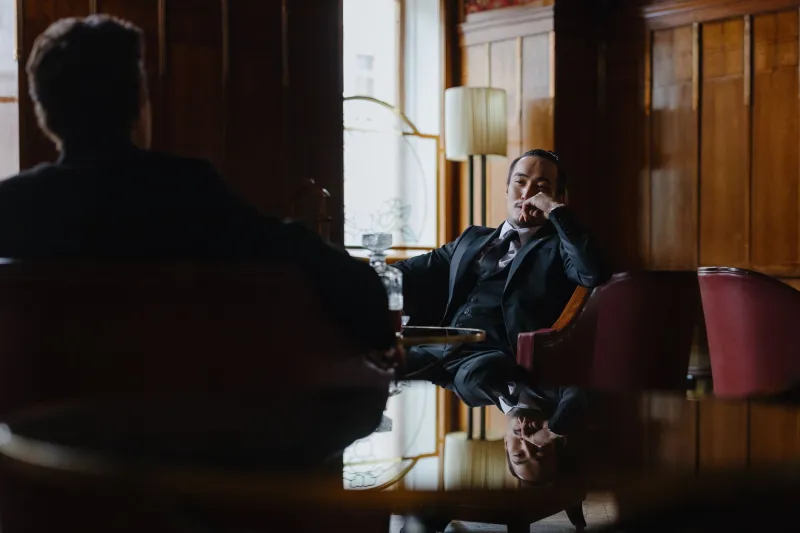
For the better part of two decades, the prevailing wisdom held that visibility was currency. Build the platform. Cultivate the following. Curate the persona. The logic seemed unassailable: in an attention economy, those who captured the most eyeballs accumulated the most influence. Yet something remarkable is happening at the very apex of American society. The individuals who arguably need public validation the least are the ones most aggressively retreating from it — and doing so with unmistakable intentionality.
This is not the privacy of the forgotten. It is the privacy of the formidable.
The Quiet Departure from the Digital Stage
Observers of elite American culture have begun noting a distinct pattern among the country's most accomplished financiers, founders, and institutional power brokers: a deliberate and systematic reduction of their digital footprints. Social media accounts go dormant. Profiles are scrubbed of personal detail. Speaking invitations are declined with gracious but firm regularity. Where lesser peers are purchasing column inches and podcast appearances, this cohort is purchasing something far more scarce — silence.
The motivation is neither technophobia nor misanthropy. Rather, it reflects a sophisticated recalibration of how influence actually operates at the highest levels. When one's network is deep enough, when one's reputation is sufficiently established, the need to broadcast diminishes sharply. The megaphone becomes, paradoxically, a liability.
Consider the asymmetry of information that attends genuine obscurity. An executive whose views are not publicly catalogued retains a kind of strategic optionality that the perpetually visible forfeit entirely. Every published opinion is a constraint; every documented position a potential vulnerability. Those who operate beneath the threshold of public scrutiny enjoy a freedom of thought and action that no amount of brand management can replicate.
The Psychology of Selective Presence
Behavioral researchers have long understood that scarcity amplifies perceived value. What is rare commands attention precisely because of its rarity. The same principle applies with striking fidelity to human presence. When a figure of genuine consequence does appear — at a select gathering, in a private forum, within a carefully chosen context — the weight of that appearance is magnified considerably by its infrequency.
Members of America's most exclusive private communities speak to this phenomenon in consistent terms. Presence, when rationed, becomes an event. The individual who attends every conference, who comments on every development, who is perpetually available for comment, gradually loses the gravitational pull that made them notable in the first place. The individual who appears selectively, whose time is visibly finite and fiercely protected, commands a different quality of attention entirely.
This is the essence of what might be called the prestige of restraint. It is not absence for its own sake, but a disciplined management of one's public surface area — an acknowledgment that in certain rarefied circles, being seen too much is indistinguishable from being seen too cheaply.
What Strategic Obscurity Actually Looks Like
For those accustomed to measuring status through follower counts and media mentions, the practical mechanics of strategic obscurity can seem counterintuitive. It manifests not in dramatic gestures of withdrawal but in a series of quiet, consistent choices.
It is the decision to communicate through intermediaries rather than public statements. It is the preference for intimate, invitation-only gatherings over industry conferences. It is the cultivation of deep relationships within a deliberately narrow circle rather than the relentless expansion of a public network. It is the willingness to allow one's work and results to constitute the entirety of one's public record.
In practical terms, those who practice strategic obscurity tend to invest their social capital with extraordinary care. A single dinner with the right individuals carries more transactional weight than a thousand social media impressions. A reputation built through the testimony of trusted peers is more durable — and more actionable — than any personal branding campaign.
The Counter-Cultural Dimension
There is something genuinely subversive about this trend, and those who have embraced it are not unaware of the irony. In a cultural moment that celebrates radical transparency, that valorizes the founder's journey and the executive's personal struggles, choosing deliberate invisibility is a form of quiet defiance.
It signals, without announcement, that one does not require external validation. That one's sense of self and purpose is sufficiently anchored to survive — indeed, to flourish — without the affirmation of an audience. This is a posture that is genuinely difficult to manufacture and consequently difficult to fake. Authentic obscurity, unlike authentic branding, cannot be performed. It can only be practiced.
For the members of organizations like Acropolis Club, this principle resonates with particular clarity. The value of an exclusive environment lies precisely in the quality of those who inhabit it — and quality, by definition, is not determined by public vote. The most consequential conversations, the most meaningful connections, and the most significant decisions tend to occur in spaces defined by their selectivity, not their visibility.
Redefining What Power Looks Like
The broader implication of this shift is a quiet but meaningful revision of what power looks like in contemporary America. For a generation raised to associate influence with platform, the emergence of the deliberately obscure as a distinct and formidable cohort represents a genuine conceptual challenge.
Power, it turns out, does not require an audience. In many cases, it is actively undermined by one. The most consequential figures in American finance, technology, and civic life are increasingly those whose names do not trend, whose opinions do not populate feeds, and whose movements are not tracked by the professional class of observers devoted to such things.
They are influential not because they are visible, but because they are trusted. Not because they are known to many, but because they are known deeply by few. Not because they have cultivated a persona, but because they have built a record.
In this light, strategic obscurity is not a retreat from ambition. It is ambition operating at its most refined — stripped of performance, focused entirely on consequence, and indifferent to the approval of those who will never be in a position to appreciate its sophistication.