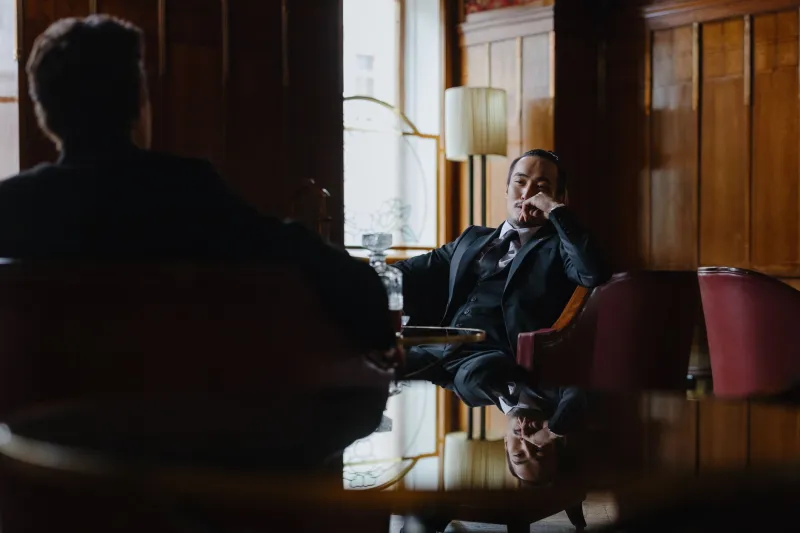
The Power of the Pause: How America's Most Formidable Leaders Weaponize Silence

There is a particular kind of authority that announces itself not through words, but through their deliberate absence. In the corridors of private equity firms, across the mahogany tables of family offices, and inside the invitation-only gatherings where America's most consequential decisions are made, seasoned leaders have long understood something that the loudest voices in the room have not: information withheld is often more valuable than information shared.
Strategic silence — the disciplined, intentional choice to communicate less than one knows — has emerged as one of the defining characteristics of truly elite decision-making. It is not passivity. It is not uncertainty dressed in restraint. It is, at its most refined, a form of leverage that the most effective executives, entrepreneurs, and institutional leaders deploy with the same deliberateness as any other competitive instrument.
The Negotiating Table as a Theater of Restraint
Consider the dynamics of a high-stakes acquisition. When a well-capitalized buyer approaches a target company, every word exchanged in early conversations carries weight far beyond its surface meaning. Seasoned dealmakers understand that premature enthusiasm — even a single phrase that signals urgency or eagerness — can shift the negotiating balance irreversibly.
In documented accounts from senior partners at several of the country's most prominent private equity firms, the pattern is consistent: the most advantageous terms are frequently secured not by the party that speaks most persuasively, but by the one that reveals least about its own position. A measured pause after a counterproposal, an unhurried response to an opening offer, or the deliberate choice to let a conversation end without resolution — these are not accidents of temperament. They are calculated moves in a long game.
This principle extends well beyond M&A activity. In venture capital, the decision to remain publicly silent about a pending investment — even when competitors are circling — has repeatedly allowed sophisticated investors to close at more favorable valuations before market awareness inflates the price. The deal that is never discussed is the deal that closes on one's own terms.
Discretion as Reputational Architecture
Beyond the negotiating table, strategic silence functions as a form of personal brand construction that no marketing campaign can replicate. In the circles where genuine influence is exercised, the individual who speaks only when certain, who never speculates publicly, and who guards confidences with absolute reliability becomes something rare and extraordinarily valuable: trustworthy at the highest level.
This quality — what might be described as institutional discretion — is the invisible credential that opens doors that résumés cannot. Board seats, advisory roles, and access to proprietary deal flow are extended not merely on the basis of track record, but on the demonstrated capacity to hold sensitive information without allowing it to leak, consciously or otherwise, into one's social or professional communications.
The reputational cost of indiscretion, by contrast, is steep and often permanent. In close-knit elite networks — where the same three hundred individuals appear across overlapping boards, charitable foundations, and private clubs — a single instance of premature disclosure can quietly close doors that may never reopen. The social architecture of these communities depends entirely on the expectation that what is shared in confidence remains there.
Silence in the Age of Overexposure
The contemporary environment makes strategic silence considerably more difficult — and therefore considerably more valuable — than it once was. The proliferation of social media, the expectation of constant commentary, and the cultural premium placed on visible engagement have created enormous pressure on even senior executives to perform transparency in real time.
The leaders who resist this pressure most effectively tend to be those who have internalized a distinction that is simple to articulate but genuinely difficult to practice: the difference between being known and being understood. Presence and authority are not synonymous. A carefully cultivated scarcity of public statement can generate far more professional gravitas than a continuous stream of commentary, however polished.
Several of the most consistently effective chief executives in American industry have made this their operational philosophy. They respond to media inquiries sparingly, they do not participate in the public discourse around their own industries unless they have something definitive to contribute, and they treat their opinions on pending matters as proprietary assets — not to be distributed freely.
The Internal Discipline Required
What is often underestimated about strategic silence is the degree of internal discipline it demands. It is not sufficient to simply speak less. The leader who wishes to leverage discretion as a competitive tool must also cultivate the capacity to tolerate ambiguity in others — to resist the impulse to fill silence with reassurance, to allow counterparties to sit with uncertainty, and to refrain from the very human desire to be understood before one is ready to be understood fully.
This requires a particular form of emotional regulation that is rarely discussed in executive development contexts but is consistently observable among those who operate at the highest levels. It is the ability to be comfortable in the space between information and action — to let a situation breathe before committing to a position.
Coaches and advisors who work with senior leaders in confidential capacities often describe this quality as one of the clearest differentiators between executives who plateau at a certain level of influence and those who continue to ascend. The latter group, almost without exception, has learned to treat their own words as a finite and precious resource.
Cultivating the Practice
For those who aspire to operate at the level where strategic silence becomes meaningful, the cultivation of this practice begins with several concrete commitments. The first is the discipline of delayed response — allowing a measured interval between receiving information and reacting to it, in both written and verbal communication. The second is the habit of audience analysis: before any communication, identifying precisely what the recipient needs to know, rather than what one is inclined to share.
The third, and perhaps most consequential, is the development of what might be called a confidentiality instinct — an automatic, reflexive sense of which information belongs in a conversation and which does not. This instinct is not innate. It is built through experience, through observing the consequences of disclosure and restraint over time, and through deliberate attention to the unspoken rules that govern elite professional communities.
At its highest expression, strategic silence is not a technique. It is a disposition — one that signals, to those who recognize it, that they are in the presence of someone who understands that power, at its most refined, does not announce itself. It simply acts, at the moment of its own choosing, with the full advantage of everything it chose not to say.